
The starting problem
Tumor suppression
Multiple signals converge on the same T cell.
Activity can decline.Our Science
Solid tumors use multiple pathways to shut down CAR-T cells. We combine protections within the same cell to help it keep working.
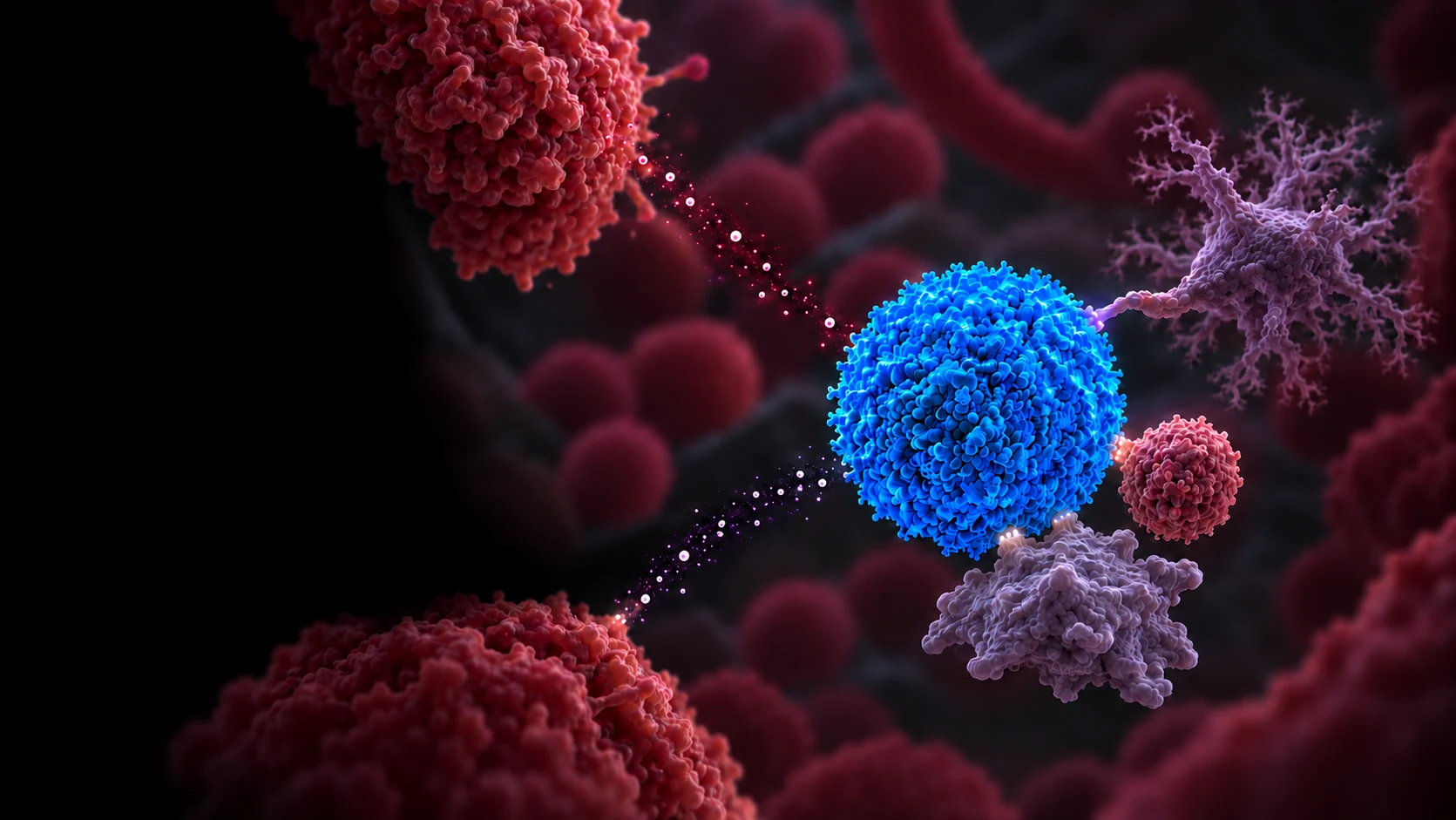
Why activity fades
GBM shuts them down through overlapping signals.
Block one signal, others remain.
KiraGen’s approach
The starting problem
Multiple signals converge on the same T cell.
Activity can decline.Common approach
Cytokine armoring or removing internal activity brakes
Can increase toxicity risk.Common approach
TGF-β or PD-1 blockade
Other suppressive signals remain.KiraGen’s approach
Multiplex gene editing
Designed for sustained activity.Why now
Blood cancers · 2025 publication
Base-edited donor CAR-T cells have induced remissions in T-cell leukemia, allowing nine patients to proceed to stem-cell transplantation.
Chiesa et al., NEJMRecurrent GBM · 2025 announcement
T-Maximum announced FDA clearance to initiate a Phase 2 trial of donor-derived MT027 in recurrent glioblastoma.
T-Maximum announcementHuman GBM · 2026 publication
Analysis of a recurrent GBM CAR-T trial linked suppressive immune-cell populations with poorer outcomes, helping define barriers to address.
Freeburg et al., CellExternal clinical and biological precedents, not KGEN-001 results.
Focus + transfer
Reuse the engineering foundation. Match protection to each tumor.
Lead program · Preclinical development
Externally funded pilots
CNS extension
Grant-supported
Dedifferentiated liposarcoma
Partner-funded pilot underway